Sealed tenders. A record you can check.
SealedChoice helps a buyer select a supplier through encrypted bids, a rubric published before bidding, recorded evaluation and a human award. Payment comes from the tender's escrow on NEAR.
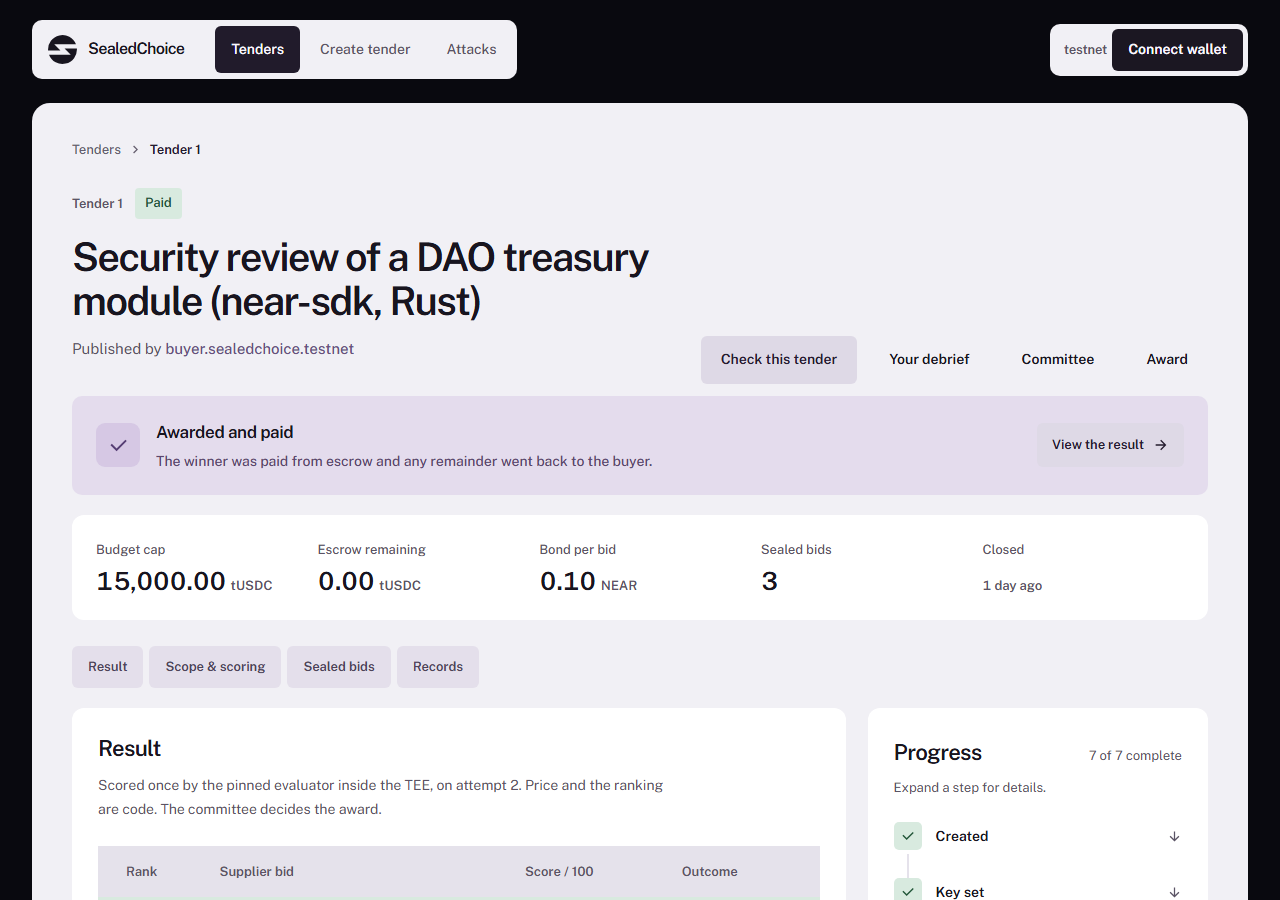
Recorded testnet tender 1. You can inspect the record without connecting a wallet.
Start with the record
The current demonstration contains three completed tenders on tenders-v1.sealedchoice.testnet. The first awards the highest-ranked eligible bid. The second records a committee decision to select a lower-ranked bid with a written reason. The third records ten manipulation attempts and their outcomes.
This is a testnet prototype. tUSDC is a test token. The demo is a record of completed tenders, rather than a continuously open bidding competition. See demo evidence for the transactions and security and limits for the retained operator keys and trust assumptions.
The process
- Publish: the buyer fixes the rubric, deadline, committee, bond and evaluator reference when creating the tender.
- Seal: suppliers encrypt bids in their browsers to the tender's public key. The chain receives ciphertext.
- Evaluate: after the deadline, the contract freezes the bid set and requests the pinned evaluator in an OutLayer TEE. Code handles eligibility, prices, totals and ranking. Models assess the text criteria.
- Decide and pay: a human committee makes the award. The winner accepts, and the contract transfers the award from escrow.
Read deeper
Learn the architecture, inspect the scoring rules, or run the project locally. For common questions about wallet access, privacy and the recorded demos, see the FAQ.